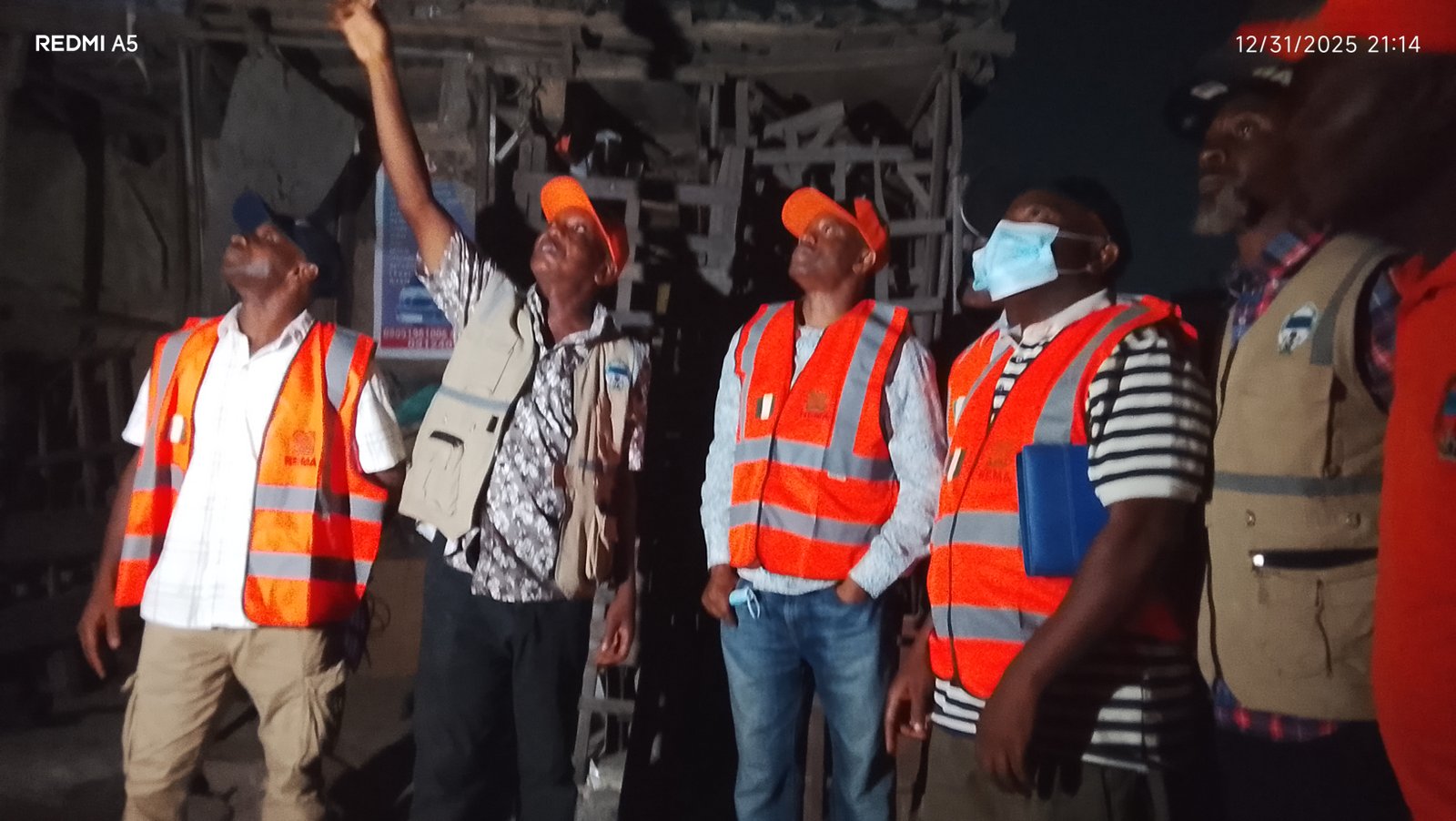
In a decisive move to escalate the emergency response to a major urban fire, the National Emergency Management Agency (NEMA) has deployed a specialized technical team from its Abuja headquarters to Lagos. This intervention underscores the severity and complexity of the ongoing blaze at the Great Nigeria Insurance House on Lagos Island, which has challenged local responders for over a week.
By Fabian Ekeruche
Lagos, Jan. 1, 2026 (NAN) The deployment, approved by NEMA’s Director-General, Mrs. Zubaida Umar, represents a critical shift from local to national-level incident management. The team, led by the agency’s Director of Search and Rescue, Air Commodore Usman Bature, arrived Wednesday night and immediately proceeded to the site on Martins Street. Their mandate is not to replace local efforts but to provide high-level technical support and enhance the coordination of the multi-agency response at the 22-storey building, a task that has proven formidable.
This incident highlights a recurring vulnerability in dense urban centers like Lagos Island: high-rise fires. The fire, which broke out on Dec. 24, 2025, originated on the upper floors—a location that immediately complicates firefighting due to access and water pressure challenges. It then spread through warehouses and offices, a progression that points to potential issues with compartmentalization and fire-load management within the structure.
Upon arrival, Air Commodore Bature held an operational meeting with on-ground responders and conducted a preliminary assessment. His immediate priority, as stated, is a dual mandate: to expedite rescue and recovery while rigorously ensuring the safety of both emergency workers and the public. This balance is crucial in prolonged incidents where structural integrity is compromised, and the risk of collapse or secondary incidents is high.
The composition of stored materials—reportedly large quantities of textile—has been a significant factor. Textiles are Class A combustibles; they provide a high fuel load, allowing fire to spread rapidly and burn with intense heat, generating toxic smoke. This directly “intensified the blaze and complicated response operations,” as confirmed by NAN, making suppression efforts more dangerous and less effective with standard approaches.
Mr. Mohammed Olatunde, Head of NEMA’s Lagos Operations Office, provided a sobering situational update: six persons have been recovered, while 13 others with various injuries were treated and discharged. The term “recovered” in emergency management terminology often, though not exclusively, refers to fatalities, indicating the grave human cost of the disaster. The ongoing risk to adjoining buildings has also prompted authorities to consider demolition and continuous safety assessments, a common but complex post-fire protocol in crowded urban districts.
The deployment of a federal technical team is a strategic resource mobilization. It signals that the incident has exceeded a certain threshold of complexity, requiring specialized skills in areas like structural assessment, advanced search and rescue planning, and inter-agency logistics that may be beyond the scope of a single state’s resources. Bature reaffirmed NEMA’s commitment to work with the Lagos State Emergency Management Agency (LASEMA), federal and state fire services, and security agencies. This layered response—local, state, and federal—is the cornerstone of effective disaster management in Nigeria, though its coordination is often the greatest challenge.
As operations continue, the public awaits further updates. This incident serves as a stark reminder of the fire safety imperatives for high-rise buildings, especially those used for commercial storage, and the critical need for interoperable communication and command structures among the nation’s emergency services.
(NAN) FBO/COF
==================
Edited by Christiana Fadare