By Deborah Akpede
Lagos, Jan. 5, 2026
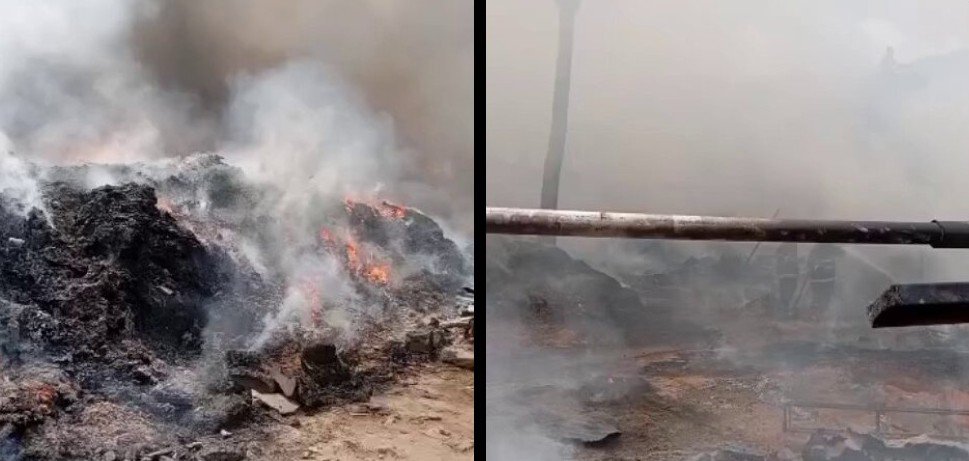
A significant fire outbreak on Monday, January 5th, 2026, has starkly highlighted the hidden dangers of unregulated urban waste management. The blaze, which ignited in an informal recycling space, rapidly escalated, gutting the site and spreading to adjacent structures along Pipeline Road, off Ekoro Road in the Abule Egba area of Lagos.
Mrs. Margaret Adeseye, the Controller-General of the Lagos State Fire and Rescue Service, confirmed in a detailed statement that a distress call was received at 1:08 p.m. Firefighting crews from the Agege and Abesan stations were immediately mobilized to confront the incident at No. 15, Pipeline Road.
Beyond the Blaze: The Anatomy of an Informal Recycling Hub
Preliminary investigations point to the fire’s origin in an “open space used for local recycling activities.” This phrase, common in official reports, often belies a complex and hazardous reality. Such sites are typically informal aggregations where individuals collect, sort, and process recyclables like plastics, metals, and electronics. The materials stored—including flammable plastics, residual chemicals, and compressed papers—create a highly combustible environment. Without proper zoning, firebreaks, or safety protocols, these community-level operations, while economically vital for waste pickers, become persistent fire risks nestled within residential areas.
The fire’s progression was tragically predictable. Adeseye reported that the initial conflagration “later spread to a nearby residential bungalow and a mini church, causing damage to the affected structures.” This domino effect underscores the vulnerability of densely populated, informally planned neighborhoods where safety buffers between commercial or industrial activities and homes are nonexistent.
Emergency Response and the Human Cost
The swift deployment of fire crews proved critical. Their efforts brought the fire under control and, most importantly, prevented a catastrophic spread to the many adjoining properties characteristic of Lagos’s urban fabric. One adult female suffered from shock at the scene—a common trauma in such disasters—and was successfully stabilized by on-site emergency medical responders. Authorities confirmed no fatalities, a testament to the effective emergency response.
A Recurring Nightmare with Systemic Roots
While investigations into the exact cause are ongoing, this incident is not isolated. Fires at informal recycling and waste dumps are a recurrent challenge in rapidly growing megacities like Lagos. Potential triggers include:
- Spontaneous Combustion: Chemical reactions within piles of waste or improperly stored batteries.
- Electrical Faults: From makeshift wiring used on-site.
- Open Flames: Used in processes to burn off plastic coatings from wires.
- Accidental Ignition: From discarded smoking materials or nearby cooking fires.
Controller-General Adeseye reaffirmed the agency’s commitment to protecting lives and property and issued a crucial plea for residents to “comply strictly with fire safety regulations.” However, this incident raises deeper questions about regulation and urban planning. How can cities formally integrate the essential work of informal recyclers into the waste management chain while mandating and enabling safe operating standards? Solutions may lie in designated, serviced recycling zones, community safety training, and incentives for formalizing these critical operations.
The fire on Pipeline Road is more than a news brief; it is a urgent signal. It calls for a coordinated approach that addresses not just fire response, but the underlying urban planning, economic informality, and environmental governance challenges that allow such dangerous—and preventable—conditions to persist. (NAN)
Edited by Kamal Tayo Oropo
Source link