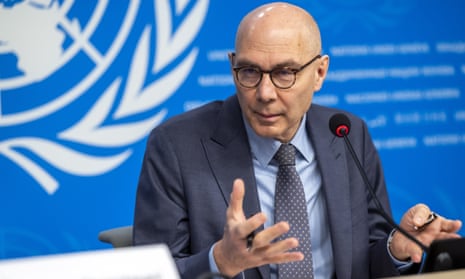
The United Nations’ top human rights official has issued a stark warning that the unilateral military intervention in Venezuela, culminating in the seizure of President Nicolás Maduro by the United States, has created a perilous new chapter for international law and the Venezuelan people. High Commissioner for Human Rights Volker Türk, through his spokesperson Ravina Shamdasani, stated that the action fundamentally undermines global security and the rights of Venezuelans to determine their own future.
In a detailed briefing in Geneva, Shamdasani systematically rejected the U.S. justification—pointing to the Maduro government’s “longstanding and appalling” human rights record—as a lawful basis for intervention. “Accountability for human rights violations cannot be achieved by unilateral military intervention in violation of international law,” she insisted. This stance highlights a core tension in global governance: the conflict between the principle of state sovereignty and the international community’s “Responsibility to Protect” populations from atrocities. The UN position firmly prioritizes the former in this instance, arguing that the intervention itself damages the very architecture—the UN Charter—designed to maintain peace.
The Office of the High Commissioner for Human Rights (OHCHR) is acutely familiar with Venezuela’s crisis, having been expelled from the country in February 2024 following its consistent reporting on the deteriorating situation. Independent investigations mandated by the UN Human Rights Council have documented grave, systematic abuses against political opponents, including arbitrary detention, torture, and extrajudicial killings. The UN’s point is not to defend the Maduro government’s record, but to assert that violating sovereignty sets a dangerous precedent that “makes all States less safe.” As Shamdasani explained, the Charter’s prohibition on the threat or use of force against a state’s territorial integrity is a cornerstone meant to prevent a return to a lawless world order.
The immediate aftermath of the intervention has seen a worrying crackdown within Venezuela. Authorities declared a state of emergency, restricting free movement, enabling property seizure for “national defence,” and suspending the rights to assembly and protest. “We’re particularly concerned, given the record that the Government has in suppressing free speech… using the pretext of national security,” Shamdasani noted. This suggests the intervention may have provided a rationale for further repression, potentially worsening the human rights situation it purported to address—a classic paradox of armed intervention.
Beyond the political and security crisis lies a profound humanitarian emergency that predates the recent military action. Nearly eight million Venezuelans—one in four—require humanitarian assistance after years of economic collapse, hyperinflation, and failed public services. The UN aid coordination office (OCHA) reports that 900,000 people have “very high” multisectoral needs, lacking adequate food, healthcare, and education. “For the broad mass of people, their humanitarian day-to-day situation hasn’t changed that radically,” said OCHA’s Jens Laerke, emphasizing that the core crisis of state failure persists. Despite being one of the world’s least-funded aid operations, UN agencies reached some two million people with assistance in 2025.
The regional displacement crisis also remains a critical concern. The UN refugee agency (UNHCR) reports that nearly 7.9 million people have fled Venezuela, with over 6.9 million sheltering in Latin American and Caribbean countries. While no major new cross-border displacement was immediately triggered by the weekend’s events, the instability threatens to disrupt fragile integration efforts and could spark new outflows. UNHCR continues to work on inclusion and solutions for displaced Venezuelans, a task now complicated by heightened political uncertainty.
The High Commissioner’s call is ultimately for a return to principles: respect for international law, human rights, and the self-determination of the Venezuelan people. “The future of Venezuela must be determined by the Venezuelan people alone,” Shamdasani stated, underscoring that true accountability must come through a fair, victim-centred process rooted in law, not force. The path forward, as outlined by the UN, requires the U.S., Venezuelan authorities, and the international community to de-escalate, protect civilians, and support a legitimate, sovereign political process that addresses both the profound humanitarian suffering and the long-denied demands for justice and rights.