An investigation by the News Agency of Nigeria (NAN) reveals a stark contrast between the promise of a “model” education and the crumbling reality at Iworo-Ajido Model College in Badagry, Lagos. During their Annual General Meeting, alumni returned to a scene of profound infrastructural decay, painting a picture of a system failing its most vulnerable students.

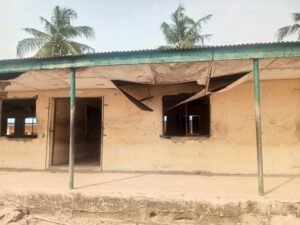
One of the Iworo-Ajido College classrooms, showcasing a leaking roof and damaged windows—a visual testament to the neglect described by alumni and staff.
By Raji Rasak
Badagry (Lagos State), Dec. 28, 2025 (NAN)
The alumni of Iworo-Ajido Model College, Ebute-Olofin Badagry Old Student Association (IAMCOSAEB), convened on Sunday not just for reunion, but for a sobering reckoning. The state of their alma mater, officially designated a “model college” a decade ago, was described uniformly as “pathetic” and “deplorable.” Their lamentations point to a crisis far deeper than simple wear-and-tear, touching on issues of educational equity, government accountability, and the social contract.
A Legacy Lost: From Functioning Labs to Students on the Floor
The Association’s President, Mr. Okelowo Oyedele (Class of 1983), highlighted the precipitous decline. “I remembered we had a laboratory for Science Students,” he stated, contrasting past standards with present assessments. “Now, we desperately need Lagos State Government (LASG) intervention.”
This sentiment was echoed powerfully by the Vice-President, Mrs. Margaret Olusanya (also Class of 1983), who was the college’s first female science student. “Those years, science laboratories were functioning well,” she recalled. “But today… the lab has not been in use in the last decade. Even the classes we used are gone. All infrastructure is overdue.” The consequence of this decay is shockingly basic: a critical shortage of desks and chairs. Both principals confirmed that all JSS1 and SS1 students are forced to sit on the floor to learn and write. Mrs. Olusanya noted the indignity of students bringing “their mother’s wrappers to school to sit on,” calling the situation “ridiculous.”

Prof. Olusegun Whenu, an alumnus and lecturer at Lagos State University, presents a cash reward to an outstanding student—a gesture of hope amidst systemic failure.
The “Model College” Paradox and the Promise of Intervention
President Oyedele pinpointed a core grievance: the school was reclassified as a model college ten years ago but was never given the “prototype building” afforded to others. This creates a two-tiered system within the state’s own model program, leaving Iworo-Ajido in a perpetual state of neglect while bearing a title that promises excellence. The school serves over 1,000 students from seven communities in Badagry, making its condition a regional educational emergency.
In the face of government inaction, the alumni association has stepped into the breach, purchasing desks and tables for over 100 students. However, as Prof. Olusegun Whenu (LASU) pointed out, “government can’t do it alone,” questioning the absence of corporate social responsibility from local industries.
There is a glimmer of bureaucratic hope. Mr. Paul Akinyele, Personal Assistant to the Permanent Secretary of Education District Five, stated that the ministry had recently assessed the school and that the long-awaited prototype building is assured for construction in 2026. This promise, however, hangs in the balance against the daily reality described by Rev. Omodele Aminu, Principal of the Senior College: “Unfortunately, when it rains, the roof of most classrooms leaks thereby making students to run from one building to another.”

The Principal of Iworo-Ajido Senior College, Rev. Omodele Aminu, confirms the dire situation, stating all SS1 students sit on the floor.
A Microcosm of a Broader Crisis
The case of Iworo-Ajido Model College is not an isolated incident but a potent symbol of challenges plaguing public education infrastructure in many regions. It raises urgent questions:
- Accountability in Designation: What oversight exists for schools labeled “model,” and how are they maintained to justify that title?
- Equity of Investment: Why do disparities in infrastructure persist between schools within the same state program?
- Immediate vs. Long-Term Solutions: While a 2026 building promise is noted, what immediate relief is available for students currently sitting on leaky, wet floors?
The alumni’s lament is more than nostalgia; it is a call to action grounded in comparative experience. They witnessed the school’s functional past and now document its distressed present. Their advocacy, coupled with the staff’s desperate management of “what we have,” underscores a community striving for dignity in education. The financial rewards given to excellent students and staff during the meeting, as reported by NAN, are a poignant counterpoint—recognizing achievement within an environment that systematically undermines it. The year 2026 will be a critical test of whether official promises can mend broken roofs and restore a foundation for learning.
Edited by Funmilayo Adeyemi
========
ROR/FAK/