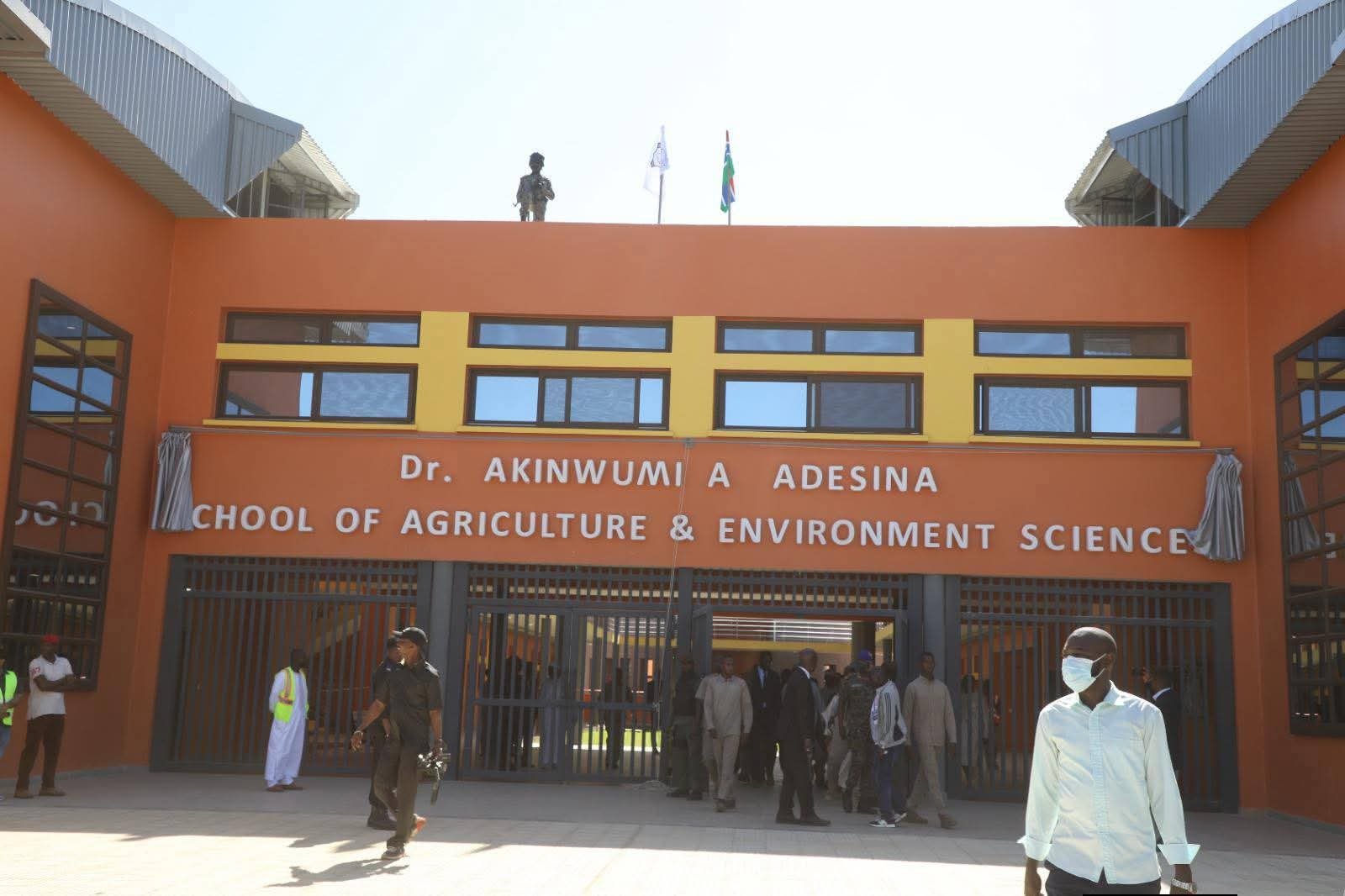
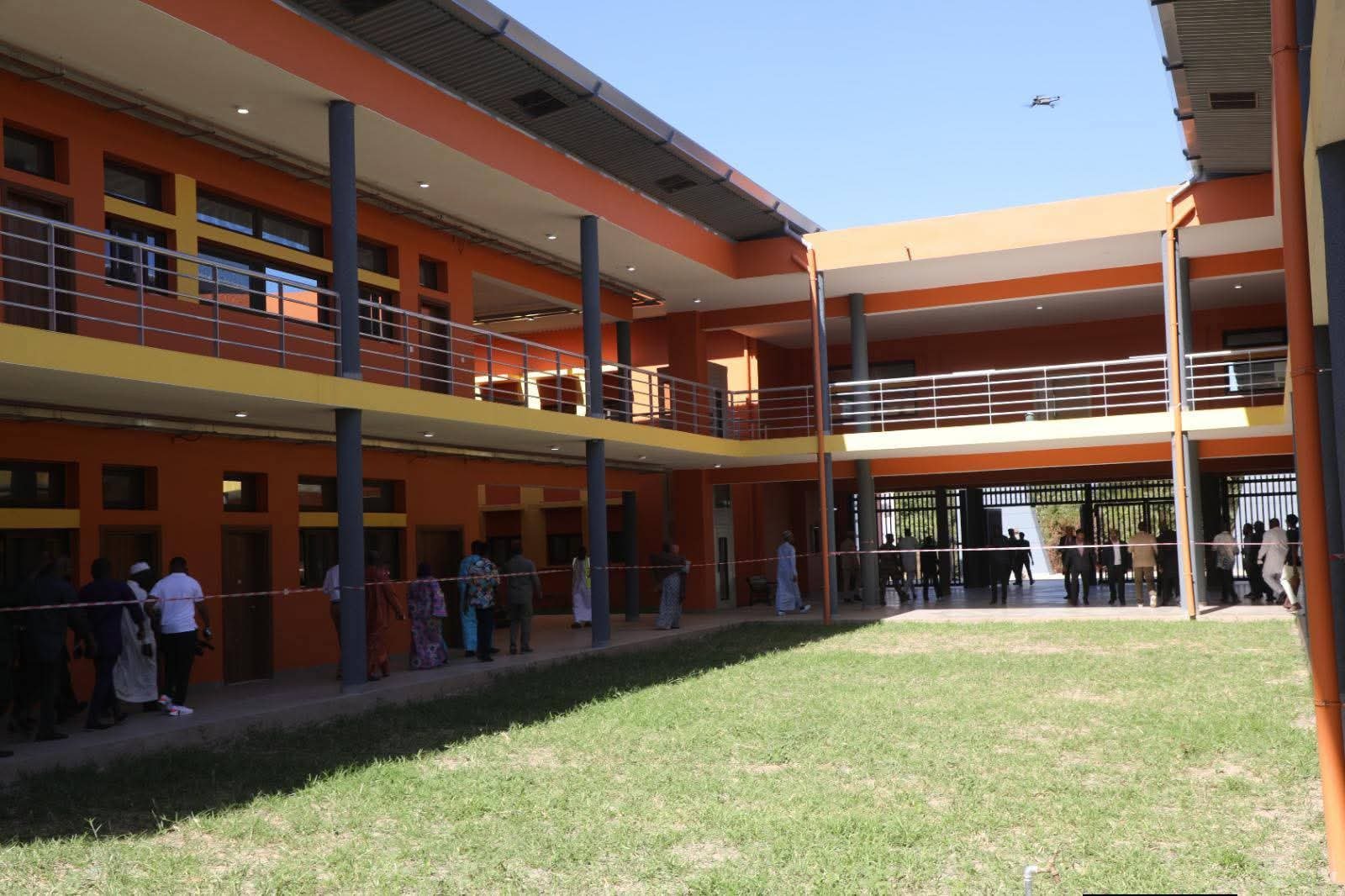
In a powerful gesture that bridges academic legacy with continental impact, the University of The Gambia has permanently etched the name of a transformative African leader into its institutional fabric. The university’s School of Agriculture and Environmental Sciences has been formally renamed the Dr. Akinwumi Adesina School of Agriculture and Environmental Sciences, honoring the former President of the African Development Bank Group (AfDB). This move transcends a simple naming ceremony; it represents a strategic alignment of academic mission with a proven blueprint for Africa’s development.
By Taiye Olayemi
Lagos, Jan. 1, 2026
The formal unveiling of the commemorative plaque by His Excellency President Adama Barrow on Wednesday marks a culmination of The Gambia’s appreciation for Dr. Adesina’s decade of visionary leadership (2015-2025) at the AfDB. The honor specifically recognizes his unparalleled contributions to agriculture, food security, and environmental sustainability across the continent—a focus desperately needed in a world facing climate change and supply chain disruptions.
Beyond a Name: The “High 5s” Legacy That Inspired the Honor
The renaming is rooted in tangible, life-changing results. Dr. Adesina’s tenure was defined by the AfDB’s “High 5s” operational strategy, which served as a masterplan for inclusive growth:
- Light Up and Power Africa: Addressing the fundamental energy deficit that hampers economic activity.
- Feed Africa: The cornerstone of his legacy, aiming to make Africa self-sufficient in food production.
- Integrate Africa: Breaking down trade and transport barriers to create a single, vibrant continental market.
- Industrialize Africa: Moving the continent up the global value chain from raw material exporter to processor and manufacturer.
- Improve the Quality of Life for Africans: Ensuring development translates into better health, education, and opportunity for all.
Bank data confirms this strategy directly impacted over 535 million people. Furthermore, Adesina’s financial stewardship saw the AfDB’s capital base soar from $93 billion to a historic $318 billion, all while maintaining its AAA credit rating—a testament to institutional credibility and trust.
The “Feed Africa” Strategy: From Theory to Plate
The decision to attach Adesina’s name to an agriculture and environmental sciences faculty is particularly apt. He spearheaded the groundbreaking Feed Africa Strategy, which moved beyond traditional aid models to a focus on agricultural entrepreneurship, technology, and value-chain development. A key engine of this was the Technologies for African Agricultural Transformation (TAAT) initiative, which delivered heat-tolerant wheat, drought-resistant maize, and high-yielding rice varieties directly to millions of farmers. The result? Food security for over 104 million people and a robust framework for climate-resilient farming.
A Concrete Example: The Senegambia Bridge
The honor also reflects Adesina’s impact on The Gambia itself. Under his leadership, the AfDB financed the landmark Senegambia Bridge. This critical infrastructure piece is a perfect case study in the “Integrate Africa” pillar, having drastically reduced travel time between The Gambia and Senegal, boosted cross-border trade, and enhanced regional stability—demonstrating how strategic investment in connectivity underpins agricultural market access and economic growth.
In a letter dated November 27, 2025, Gambia’s Minister of Higher Education, Research, Science and Technology, Prof. Pierre Gomez, captured the sentiment: “Your tenure… has been transformative, driving economic growth, poverty reduction and sustainable development across Africa.”
Inspiring the Next Generation
This renaming is a forward-looking investment. The university explicitly stated the gesture aims to inspire students to emulate Adesina’s vision, determination, and commitment. It transforms the faculty into a living memorial, challenging every student who walks its halls to contribute to solving Africa’s greatest challenges. This follows The Gambia’s 2023 decision to confer its highest national honor, the Grand Commander of the Order of the Republic, on Adesina, indicating a deep and sustained recognition.
In his letter of appreciation to President Barrow, Dr. Adesina described the honor as “exceptional,” stating, “It is with great humility and deep gratitude that I express my appreciation…”
The renaming of the University of The Gambia’s faculty is more than a headline. It is a strategic statement: that the path to Africa’s prosperity is inextricably linked to investing in its people, its agriculture, and its environment, guided by the lessons of transformative leadership.
Edited by Olawunmi Ashafa