Power & Industry
By Lucy Ogalue
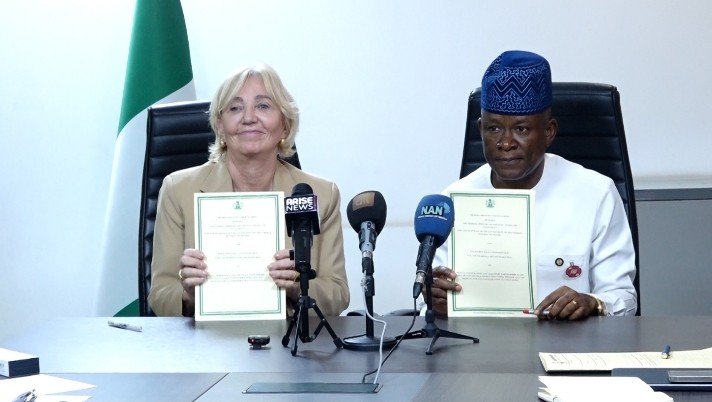
Abuja, Dec. 23, 2025 (NAN) In a significant move to tackle the perennial energy crisis crippling its industrial sector, the Federal Government has formalized a strategic partnership with RSE Energy Nigeria. The signing of a Memorandum of Understanding (MOU) marks a concrete step towards deploying dedicated off-grid and embedded power solutions for industrial clusters nationwide, a model that could redefine Nigeria’s manufacturing landscape.
During the signing ceremony in Abuja, the Minister of State for Industry, Sen. John Enoh, framed the agreement as a direct response to the most critical bottleneck facing Nigerian manufacturers. “This journey culminates at a pivotal time,” Enoh stated. “Just two weeks ago, I convened a ministerial roundtable where industry leaders unanimously identified unreliable energy as their single greatest challenge. This MOU is a direct answer to that problem.”
The minister revealed that the partnership is the result of engagements that predated his tenure, indicating a sustained governmental focus on alternative energy models. He emphasized that the MOU is not a mere declaration of intent but a document with “mutual commitments and expectations” from both RSE Energy and the Federal Ministry of Industry, Trade and Investment.
Beyond the Grid: The Promise of Embedded Power
The core of the initiative lies in its focus on off-grid and embedded power generation. Unlike the national grid, which is prone to systemic failures, these solutions involve generating power directly at or near the point of consumption—specifically for industrial clusters, special economic zones, and agro-processing hubs. Minister Enoh specified that the proposed solutions would leverage biomass and gas, two resources with significant local potential.
Context & Deeper Value: This model offers profound advantages. For industries, it promises predictable costs (shielding them from tariff hikes and grid collapse), enhanced reliability (enabling 24/7 operations), and improved competitiveness. For the nation, it reduces the immense burden on the national grid, allows for the use of localized fuel sources (like agricultural waste for biomass), and can stimulate job creation within the clusters. The Idu Industrial Cluster in Abuja has been selected as the pilot project, serving as a critical test case for scalability and reliability.
Ambassador Nura Rimi, Permanent Secretary of the Ministry, underscored the partnership’s alignment with broader national agendas, stating it serves “the overall interest of the Federal Government” and dovetails with President Bola Tinubu’s Renewable Hope Agenda and the ministry’s flagship programs.
A Partner Forged in Crisis: RSE’s Proven Experience
The selection of RSE Energy Nigeria brings a unique and battle-tested expertise to the table. In her remarks, CEO Olena Nedryhailo highlighted that the company’s approach is rooted in “responsibility and long-term thinking,” forged in the crucible of real-world crisis.
“Over the past three years, we have been directly involved in developing and deploying decentralized co-generation solutions under the severe stress on the energy system in Ukraine,” Nedryhailo explained. This hands-on experience, which involved deploying over 1,020 co-generation units to sustain industrial communities during conflict, is invaluable. It has provided RSE with unparalleled knowledge in creating resilient, scalable systems that integrate into existing networks and maintain reliability over time.
Practical Insight: This background suggests RSE is not merely selling equipment but offering a holistic system integration and management capability. Their experience in Ukraine demonstrates an ability to implement robust power solutions under duress—a relevant skill for Nigeria’s challenging operational environment. Nedryhailo positioned the company as a “long-term partner in building a stable decentralized energy system,” signaling a commitment beyond a one-off transaction.
The Road Ahead: From MOU to Megawatts
While the MOU signing is a crucial milestone, the real work now begins. Key questions for stakeholders will focus on the financing model (will industries pay directly, or is a public-private partnership envisioned?), technology rollout timelines, and the regulatory framework for embedded generation. The success of the Idu pilot will be closely watched by industrial clusters across Lagos, Ogun, Rivers, and Kano states, all desperate for a reliable power solution.
This partnership represents a pragmatic shift in Nigeria’s industrial strategy. By moving to decentralize power and partner with a firm possessing proven, crisis-hardened experience, the government is attempting to provide a targeted infrastructural solution that, if successful, could unlock billions in dormant manufacturing capacity and set a new template for industrial energy supply in emerging economies.
LCN/KAE
==========
Edited by Kadiri Abdulrahman