
Health & Policy Analysis
By Ibrahim Bello | Expert Analysis by Editorial Team
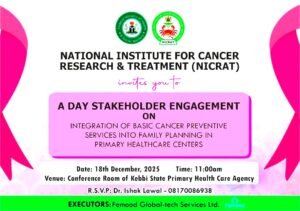
Birnin Kebbi, Dec. 18, 2025 (NAN) – In a strategic move to combat Nigeria’s rising cancer burden, the National Institute for Cancer Research and Treatment (NICRAT) has initiated a critical stakeholder engagement in Kebbi State. The goal is to integrate basic cancer prevention and screening services into the state’s existing family planning programmes, a model that could redefine primary healthcare delivery nationwide.
The engagement meeting, held in Birnin Kebbi, convened a powerful coalition essential for success: officials from the State Ministry of Health and the Primary Health Care Development Agency, traditional and community leaders, development partners, civil society organisations, and frontline health professionals. This inclusive approach recognises that sustainable public health initiatives require buy-in from both institutional and grassroots power structures.
Hajiya Zainab Ahmad, representing NICRAT, framed the initiative as a pragmatic solution to a dire national crisis. “Cancer remains a growing public health challenge in Nigeria, with a devastatingly high rate of late-stage presentation,” she stated. This is largely due to profound gaps in public awareness, cultural stigma, and a severe scarcity of accessible, organised screening services, particularly in rural and underserved regions like Kebbi.
The Logic of Integration: Why Family Planning Platforms?
The core innovation lies in its leverage of existing infrastructure. Family planning (FP) services are a cornerstone of primary healthcare with an established, wide-reaching network and frequent touchpoints with women of reproductive age—a demographic also at risk for cancers like breast and cervical cancer. Integrating screening into these routine visits transforms a single-purpose interaction into a comprehensive health checkpoint.
“This integration is not merely additive; it’s synergistic,” the analysis suggests. “It capitalises on established trust between clients and FP providers, reduces the need for separate, daunting hospital visits for screening, and optimises the use of scarce healthcare resources. For the woman, it means receiving essential, life-saving care in a familiar, convenient setting.”
Ahmad emphasised the expected outcomes: “The integration of cancer screening into family planning services will help bridge existing gaps, promote early detection, and ultimately reduce cancer-related morbidity and mortality.” Early detection is paramount; for example, cervical cancer is highly preventable and treatable when pre-cancerous lesions are identified early through simple visual inspection or HPV testing.
The NICE-SCAN Programme and the Path to Scale
This pilot falls under NICRAT’s NICE-SCAN Programme, a collaborative effort with federal and state ministries of health and development partners. Its objectives are twofold: to immediately strengthen primary healthcare systems in Kebbi, and to generate robust operational evidence and best practices for a potential national scale-up. The success in Kebbi could provide a blueprint for other states, making this more than a local project—it’s a national test case.
Dr. Ishak Lawal, NICRAT’s State Lead for the pilot and a consultant gynaecologist, underscored the importance of local ownership. “The success of this pilot depends largely on the commitment and ownership of state actors and community leaders,” he said. He revealed that plans for the service pilot are finalized, with this stakeholder meeting being the crucial launchpad. Traditional leaders, in particular, are vital for community mobilization and dispelling myths about cancer and screening.
Navigating Existing Challenges
The initiative, however, must navigate the realities of Kebbi’s healthcare landscape. Hajiya Hauwa Muhammed, the state Family Planning Focal Person, outlined significant hurdles: chronic stock-outs of family planning commodities, irregular supply of basic medical consumables, data quality issues from poor documentation, and inadequate supportive supervision for health workers.
For the cancer screening integration to work, these systemic weaknesses must be addressed concurrently. The pilot will need to ensure reliable supply chains for screening tools (like acetic acid for VIA) and establish clear referral pathways for positive cases to secondary care facilities—a major gap in many primary healthcare systems.
Despite the challenges, the stakeholder response was unanimously supportive. Participants recognised the initiative as a significant, practical step towards person-centered care and a proactive strategy to shift the narrative from costly late-stage cancer treatment to affordable, life-saving prevention.
In conclusion, the NICRAT initiative in Kebbi represents a paradigm shift in Nigerian public health strategy. By piggybacking on established services, it seeks to create a cost-effective, scalable model for cancer prevention. Its success will hinge on sustained stakeholder collaboration, resolved supply chain issues, and community education. If proven effective, it offers a powerful template for saving countless lives across Nigeria. (NAN)(www.nannews.ng)
IBI/AMM/ETA
=======
Edited by Abiemwense Moru | Expanded and Contextualized by Expert Analysis