In a definitive address outlining his strategic command priorities, the Chief of Army Staff (COAS), Lt.-Gen. Waidi Shaibu, has declared a comprehensive overhaul of the Nigerian Army’s training doctrine and welfare infrastructure as the cornerstone for achieving superior operational results in a complex threat environment.
By Oladapo Udom
Lagos, Dec. 18, 2025

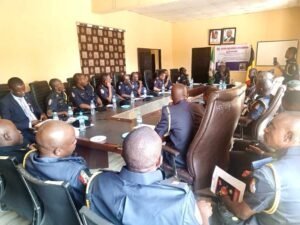
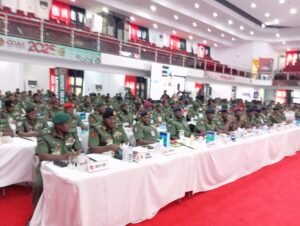
The announcement was made at the closing ceremony of the pivotal COAS Annual Conference 2025, held from December 15-18 at Nebo Hall, Abalti Barracks in Lagos. The conference served as a strategic stock-taking forum to critically assess the Army’s performance in 2025 and solidify plans for the coming year.
Lt.-Gen. Shaibu’s statement moves beyond a simple commitment to training; it presents a holistic transformation framework. “Arising from our deliberations, the Nigerian Army will immediately begin to rejig its training, operations, and other administrative and logistics concerns,” he stated. This re-alignment is directly tied to his command philosophy, which aims to forge “a more professional, adaptable, combat-ready, and resilient force.”
The Training Revolution: From Curriculum to Combat Readiness
The COAS identified a direct causal link between training quality and mission success. “I believe that realistic training directly influences operational outcomes,” he asserted, announcing a “total overhaul” of training curricula across all Nigerian Army schools. This isn’t a minor update but a codified, radical revision to be driven by the Army Headquarters’ Department of Training.
Key Implications:
- Mission-Specific Focus: Training will shift from generic exercises to tailored programs designed for specific operational theatres and threat profiles, such as asymmetric warfare, counter-insurgency, and cyber defense.
- Special Forces Enhancement: The Special Forces School was singled out for significant changes in 2026, indicating a push towards elite, rapid-response capabilities.
- Adapting to Modern Warfare: The overhaul responds to an intelligence assessment that the operating environment is “increasingly becoming more complex.” This necessitates enhanced skills in Intelligence, Surveillance, Target Acquisition, and Reconnaissance (ISTAR) and cyber operations—critical domains in 21st-century conflict.

Confronting the Evolving Threat Spectrum
Shaibu contextualized the training push within global and regional security dynamics. “Current regional dynamics with the attendant instability coupled with the global shifts in the character of warfare, requires that we continuously learn, adapt and innovate at all levels.” This acknowledgment underscores a move away from static doctrines towards a culture of continuous adaptation and technological integration, while still relying on government support for critical hardware and software procurement.
The Welfare Foundation: Building Resilience Beyond the Battlefield
In a significant expansion of the narrative, the COAS dedicated substantial attention to troop welfare, recognizing that a soldier’s focus and morale are inextricably linked to their living conditions and future security.
A Two-Pronged Housing Strategy:
- Immediate Barracks Improvement: A direct order was issued to complete all ongoing residential accommodation projects and initiate new ones across all Divisions. A “comprehensive spread of renovation works” will serve as a vital stopgap measure to alleviate the acute accommodation shortages that have long affected morale.
- Securing the Future: Perhaps more innovatively, Shaibu highlighted a groundbreaking focus on post-service housing. He announced his imminent commissioning of the “Affordable Home Ownership Option for All Soldiers” project in Ibadan. This initiative, alongside the Post-Service Housing Development Limited, aims to solve the profound anxiety soldiers face about life after service, thereby boosting long-term retention and commitment.
This welfare drive is framed not as a perk, but as a strategic imperative to build a stable, dedicated, and resilient force.
Conclusion: A Pledge of Professionalism and Loyalty
Lt.-Gen. Shaibu concluded by commending the conference organizers and extending gratitude to President Bola Tinubu for the government’s sustained support. He reaffirmed the Nigerian Army’s unwavering commitment to national defense and its “unalloyed loyalty” to the Commander-in-Chief and the Constitution.
The address, therefore, marks a clear strategic pivot. It connects realistic training for modern combat, technological adaptation for complex threats, and holistic welfare for human sustainability into a single, coherent vision for transforming the Nigerian Army into a more effective and professional institution. The success of this ambitious plan will depend on its sustained implementation and resourcing in the year ahead.
Edited by Christiana Fadare
OUU/COF
============