
By Oladapo Udom
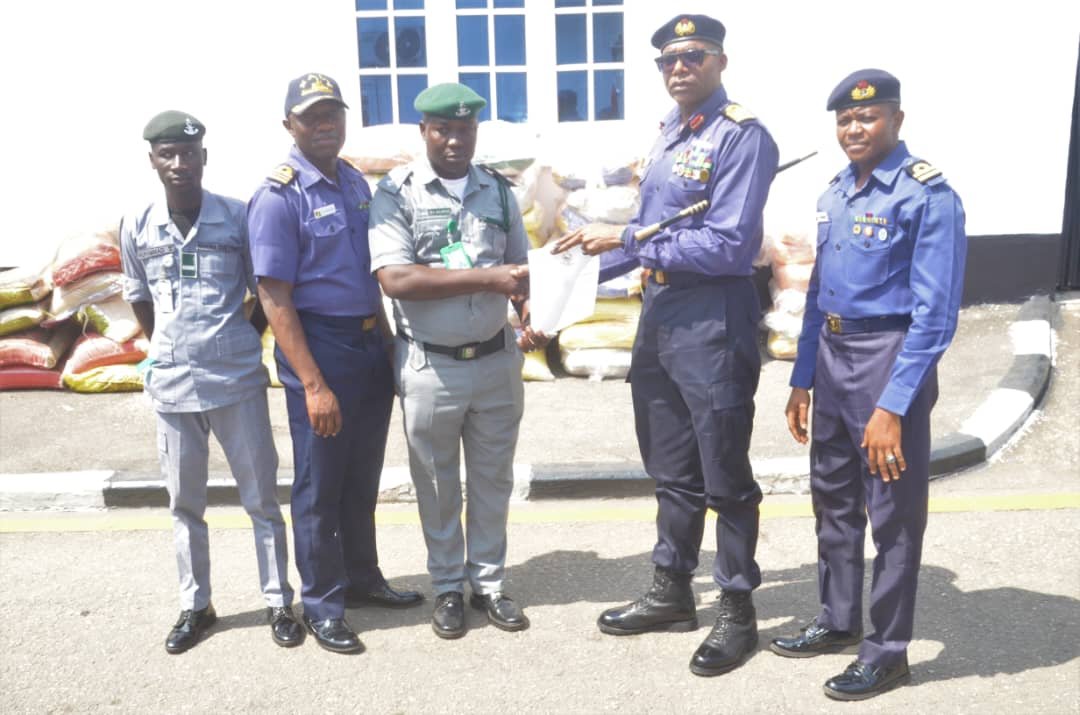
Lagos, Dec. 18, 2025 – In a routine yet significant enforcement action, the Nigerian Navy Ship (NNS) BEECROFT has formally transferred 58 bags of seized foreign parboiled rice to the Western Marine Command of the Nigeria Customs Service. This handover, detailed in a statement by Base Information Officer Lt. Hussaini Ibrahim, underscores the ongoing, multi-agency battle against smuggling that threatens Nigeria’s economy and food security policies.
The seizure itself occurred months earlier, on August 31, 2025, when a NNS BEECROFT patrol team, operating from its strategic station at Liverpool, Apapa, acted on credible intelligence. The team intercepted two wooden boats laden with the contraband. Notably, the suspected smugglers abandoned their vessels upon sighting the naval patrol—a common tactic that highlights the persistent and evasive nature of maritime smuggling networks.
Presiding over the handover, Rear Admiral Paul Nimmyel, Commander of NNS BEECROFT, framed the interception within the Navy’s broader mandate. “This operation forms part of our concerted efforts to curb illegal activities within our maritime domain,” he stated. “The Nigerian Navy abhors all forms of maritime crime, particularly contraband smuggling within Nigeria’s coastal waters. We remain committed to working with other agencies to secure the maritime domain for socio-economic activities to thrive.”
Deeper Context: Why This Seizure Matters
While 58 bags may seem like a minor haul, this event is a microcosm of a critical national issue. The smuggling of foreign parboiled rice directly undermines the Nigerian government’s long-standing policy to boost local rice production and achieve self-sufficiency. Smuggled rice, often cheaper due to subsidies in producing countries, floods the market, undercuts local farmers, and deprives the government of legitimate customs revenue.
The handover to the Western Marine Command of the Nigeria Customs Service is a key procedural step. The Customs Service is the lead agency for enforcing import restrictions and levying duties. This collaboration is essential, as the Navy provides the maritime interdiction capability, while Customs handles the legal and administrative processes, including possible destruction of the contraband or its managed disposal, and further investigation.
Rear Adm. Nimmyel’s call for public intelligence is not merely procedural. Successful interdictions often rely on tips from coastal communities about the movement of goods and the hideouts of smuggling syndicates. This “see something, say something” approach is vital for securing Nigeria’s vast and busy coastline.
The physical handover was completed with Assistant Superintendent of Customs I, Kehinde Saliman, formally receiving the items on behalf of the Western Marine Command in Apapa for “necessary action.” This closing of the loop ensures the seized rice enters the proper legal channel and demonstrates tangible inter-agency cooperation.
Conclusion
This operation by NNS BEECROFT is more than a single news item; it is a visible checkpoint in the continuous patrol of Nigeria’s economic frontiers. It highlights the critical role of maritime security forces in enforcing national economic policies, the importance of intelligence-driven operations, and the necessary synergy between the Navy and Customs in protecting the nation’s interests from the seaward flank.
(Report by NAN, www.nannews.ng)
OUU/KTO
==========
Edited by Kamal Tayo Oropo


