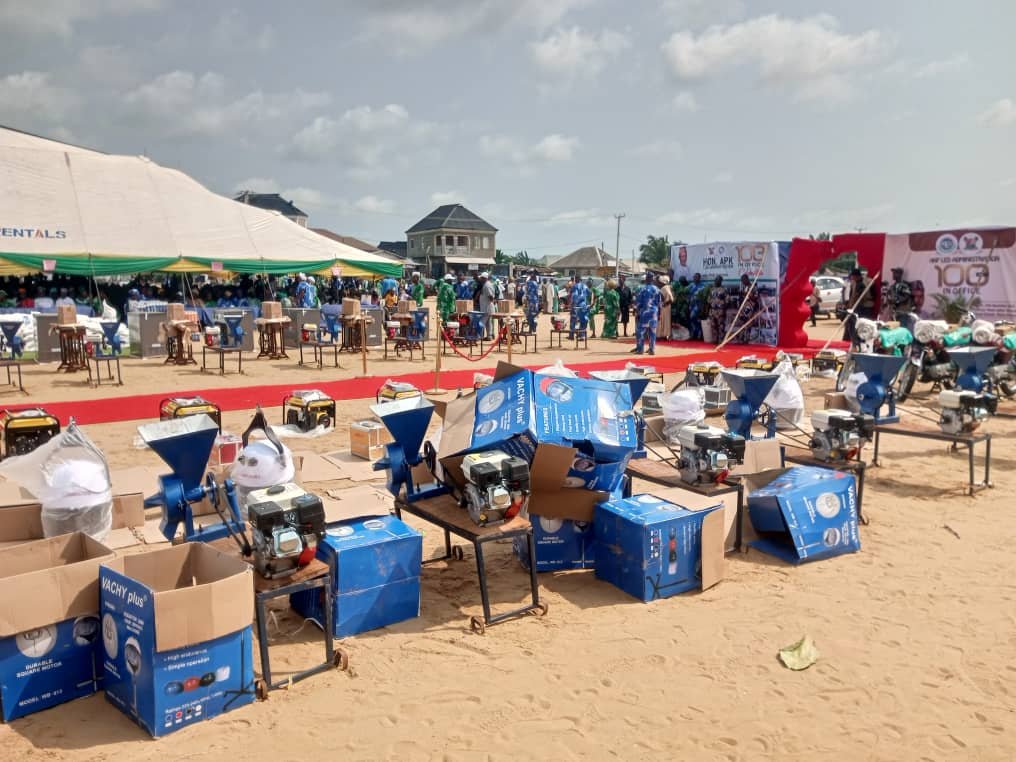
Caption: A selection of the tools and equipment distributed by Mr. Kumayon Ajose, Chairman of Olorunda Local Council Development Area (LCDA), as part of a comprehensive 100-day-in-office empowerment program.
In a significant move to translate political promises into tangible economic relief, the Chairman of Olorunda Local Council Development Area (LCDA), Mr. Kumayon Ajose, has executed a large-scale empowerment initiative, providing direct support to over 1,000 residents. The program, which marked the culmination of his first 100 days in office, was held at the Age-Mowo Model School in Badagry on December 20, 2025.
This initiative moves beyond a simple handout; it represents a strategic investment in the local economy’s foundational layers. By focusing on tools and capital for small businesses, the program directly targets the engines of community-level job creation and self-sufficiency.
Beyond Headlines: The Strategy Behind the Empowerment
Chairman Ajose framed the intervention as a core component of his administration’s “RESHAPE Agenda,” aimed at promoting self-reliance and inclusive economic growth. The distribution was meticulously categorized to address different needs within the community:
- Direct Business Support: The core of the program involved distributing essential tools for micro-enterprises, including grinding machines, chest freezers, hair dryers, sewing machines, barbering kits, generating sets, and POS machines. These items are not just gifts; they are income-generating assets that can transform a subsistence skill into a sustainable livelihood.
- Capital Injection for SMEs: Recognizing that tools alone are sometimes insufficient, the administration extended cash grants of N100,000 each to 200 Small and Medium-Scale Enterprise (SME) beneficiaries. This capital can be used for stock, rent, marketing, or other operational costs, providing a crucial buffer for business stability and growth.
- Infrastructure for Governance & Safety: The program also had broader community components. Operational vehicles were provided to councillors to enhance their mobility and effectiveness in representation. In a critical safety measure for the riverine areas of the council, life jackets were distributed to residents, addressing a specific, life-threatening need often overlooked in standard empowerment schemes.
- Rewarding Excellence & Partisan Support: The administration celebrated non-economic achievements by presenting cash rewards to winners of the APK Football Championship and a Spelling Bee competition. Additionally, five motorcycles were gifted to the ward chairmen of the ruling All Progressives Congress (APC), a move that underscores the political dimensions of such community programs.
The “Social Contract” in Action: Accountability and Sustainable Development
In his address, Chairman Ajose positioned the event as an act of accountability—a “rendering of stewardship” based on the “social contract” of the July 12 election mandate. This framing is crucial. It shifts the narrative from patronage to a reciprocal relationship between the governed and their leaders. The chairman emphasized that the celebration was “not about self-praise, but about reporting back to the people,” suggesting a governance model focused on measurable, people-centric deliverables.
The true test of this initiative’s value, however, will lie in its long-term impact. While the immediate boost to 1,000+ households is undeniable, sustainable development requires follow-up: tracking how these tools are utilized, monitoring business growth among cash grant recipients, and ensuring that such programs are not one-off events but part of a continuous cycle of support, training, and market access creation.
By combining immediate economic relief with gestures toward governance efficiency and community safety, the Olorunda LCDA’s 100-day program presents a multifaceted approach to local development. It sets a visible benchmark for performance that residents can use to measure the administration’s commitment throughout its tenure.
Reported by Raji Rasak for the News Agency of Nigeria (NAN). Edited by Yinusa Ishola/Sandra Umeh.