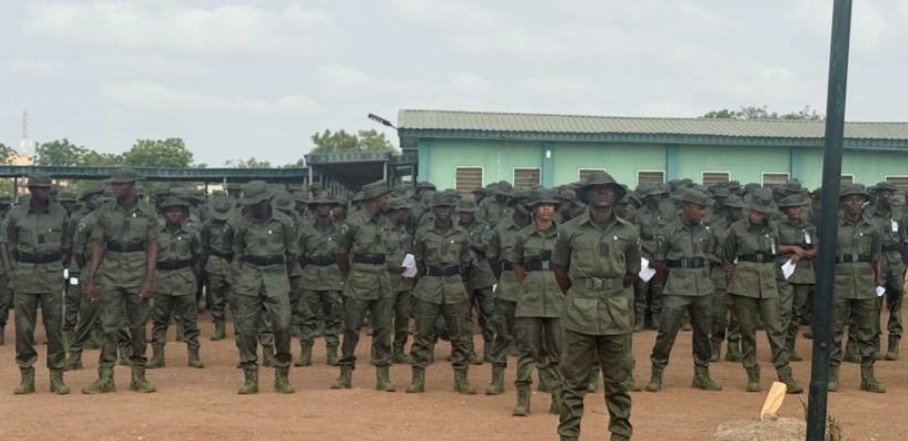
In a significant escalation of Nigeria’s counter-insurgency and anti-banditry strategy, the Office of the National Security Adviser (ONSA) has formally graduated the first cohort of over 7,000 newly recruited Forest Guards. This move marks a pivotal step in the government’s plan to deny sanctuary to criminal elements within the nation’s vast and often ungoverned forested territories.
By Collins Yakubu-Hammer
Abuja, Dec. 27, 2025 (NAN)
The graduation follows the successful completion of an intensive, three-month training programme under the Presidential Forest Guards Initiative (PFGI), launched by President Bola Tinubu in May 2025. The ceremonies were held across seven frontline states: Borno, Sokoto, Yobe, Adamawa, Niger, Kwara, and Kebbi.
A Strategic, Multi-Agency Response to a Critical Vulnerability
This initiative represents more than just a new security unit; it is a coordinated Federal-State intervention designed to address a specific and long-exploited vulnerability in Nigeria’s security landscape. For years, the country’s expansive forests—such as the Sambisa, Kamuku, and Borgu reserves—have served as ideal hideouts, training camps, and logistical bases for terrorists, bandits, kidnappers, and illegal miners. The Forest Guards initiative is a direct attempt to reclaim these spaces.
As stated by the Special Assistant on Media to the Minister of Information, Malam Rabiu Ibrahim, the programme is “aimed at reclaiming Nigeria’s forests from criminal exploitation.” Its core mission is to “strengthen Nigeria’s internal security architecture by denying terrorists, bandits, kidnappers, and other criminal groups sanctuary within forested and hard-to-reach terrains.”
Beyond Security: A Hybrid Training Curriculum
The training was deliberately structured to create a hybrid force. The curriculum uniquely integrated advanced security competencies with environmental conservation principles. This dual focus aims to produce operatives who are not only tactically proficient in surveillance, intelligence gathering, and interdiction but also understand forest ecology, enabling them to detect unnatural disturbances and illegal activities like logging or mining that often finance criminal operations.
Critically, the training placed a “strong emphasis on ethics, legality, and professionalism,” with significant modules on Human Rights, International Humanitarian Law (IHL), gender rights, and the protection of civilians. This focus is essential for building community trust and ensuring the force operates within the bounds of the law, avoiding the pitfalls of past, sometimes heavy-handed, security approaches.
The “Guardian” Role: Intelligence, Presence, and Community
National Security Adviser, Malam Nuhu Ribadu, outlined the multifaceted role of the new guards: “These Forest Guards are not just uniformed personnel, but first responders, community protectors, and a critical layer of Nigeria’s security architecture.”
Their effectiveness is deliberately rooted in local knowledge. All successful participants are indigenous to their assigned Local Government Areas. This allows them to leverage unparalleled terrain familiarity and pre-existing community trust—assets that conventional military forces often struggle to acquire. They are envisioned as the permanent “eyes and ears” within these territories, holding ground, gathering real-time intelligence, and supporting the operations of the military, police, and DSS.
Ribadu assured immediate deployment: “There will be no delay between graduation and deployment. Salaries and allowances will commence immediately, and every certified guard will proceed directly to assigned duty posts.”
Operational Structure and National Expansion
The Forest Guards initiative is a complex inter-agency endeavor. It is established under the strategic guidance of the ONSA, in collaboration with the Federal Ministry of Environment, and is operationally coordinated by the Department of State Services (DSS) and the National Park Service. Doctrine and operational alignment are drawn from the Defence Headquarters, Nigerian Army, Navy, Police Force, and the Nigeria Security and Civil Defence Corps (NSCDC), ensuring “unity of command, clarity of purpose, and operational effectiveness.”
The programme recorded a 98.2% completion rate. While 81 trainees were disqualified on disciplinary grounds and two passed away due to pre-existing medical conditions, the high graduation rate indicates a rigorous selection and training process. Ribadu confirmed the government’s commitment to expansion: “This initiative will expand nationwide as part of our sustained effort to build a safer and more secure Nigeria.”
The graduation ceremonies were attended by state executives, including Governors AbdulRahman AbdulRazaq of Kwara and Mai Mala Buni of Yobe, signaling strong sub-national buy-in, which is crucial for the initiative’s long-term sustainability and legitimacy.
Edited by Maureen Atuonwu
===
(NAN)(www.nannews.ng)
CMY/MNA