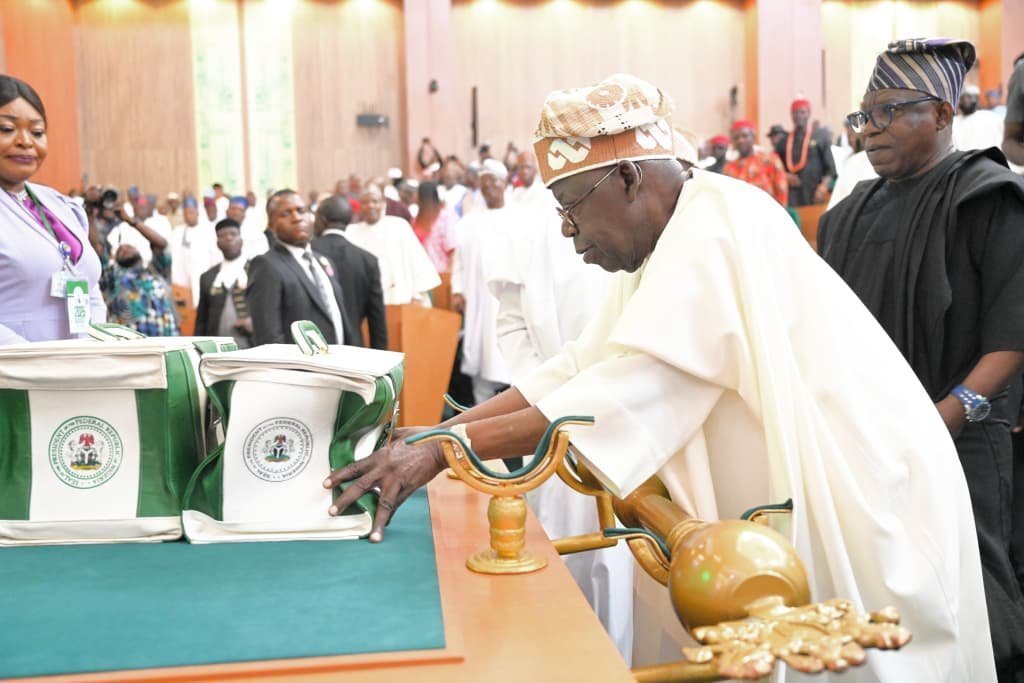
On Friday, 19 December 2025, President Bola Ahmed Tinubu presented the 2026 Appropriation Bill to a Joint Session of the National Assembly in Abuja. The speech, titled “Budget of Consolidation, Renewed Resilience and Shared Prosperity,” outlines a critical fiscal blueprint aimed at locking in recent economic gains and steering Nigeria towards inclusive growth. This analysis expands on the key themes, numbers, and implications of the proposed budget, providing context to understand its potential impact on the nation’s future.
The Foundation: Consolidating Hard-Won Reforms
President Tinubu framed the 2026 budget as the culmination of a challenging two-and-a-half-year reform period. He acknowledged the “pain” experienced by families and businesses due to policies like the fuel subsidy removal and foreign exchange market reforms. However, he presented compelling data to argue that these sacrifices are beginning to yield results:
- Growth: GDP growth edged up to 3.98% in Q3 2025 from 3.86% a year prior.
- Inflation: A significant victory highlighted was the decline in headline inflation to 14.45% in November 2025 from a peak of 24.23% in March 2025. This eight-month consecutive drop suggests monetary and fiscal policies are gaining traction, though food inflation remains a persistent concern for households.
- External Reserves: Perhaps the most striking indicator of improved stability is the rise in external reserves to a seven-year high of ~$47 billion, providing over 10 months of import cover. This buffer is crucial for defending the Naira and attracting foreign investment.
The President’s message was clear: the 2026 budget is designed to move the economy “from survival to growth” by consolidating these fragile gains.
The Fiscal Framework: Ambition Tempered by Deficit
The budget’s key aggregates reveal both ambition and constraint:
- Total Revenue: ₦34.33 trillion (a significant increase targeted from 2025’s performance).
- Total Expenditure: ₦58.18 trillion.
- Budget Deficit: ₦23.85 trillion, representing 4.28% of GDP.
- Capital Expenditure: ₦26.08 trillion (44.8% of total spending), signaling a focus on long-term projects.
- Debt Servicing: ₦15.52 trillion, a substantial portion that continues to constrain fiscal flexibility.
The budget is based on conservative assumptions: oil price at $64.85/barrel, production at 1.84 million barrels per day, and an exchange rate of ₦1,400/$. These assumptions are critical; any deviation, especially in oil production or price, could significantly alter the fiscal outlook. The deficit, to be financed by borrowing, underscores the ongoing tension between needed investment and fiscal sustainability.
Strategic Priorities: Where the Money is Allocated
The budget allocates funds to four interlinked pillars, with notable sectoral highlights:
- National Security (₦5.41 trillion): Beyond increased funding, the speech announced a profound strategic shift: a “new national counterterrorism doctrine.” This involves a “holistic redesign” of security architecture, unified command, and a stark declaration that any armed non-state actor will be classified as a terrorist. This represents a significant hardening of the state’s approach to internal security challenges.
- Infrastructure (₦3.56 trillion): Investments here are aimed at unlocking economic productivity. The focus on transport, energy, and port modernisation is intended to reduce the crippling cost of logistics for businesses.
- Education (₦3.52 trillion): The expansion of the Nigerian Education Loan Fund, supporting 788,000 students, is a direct investment in human capital and a potential tool for social mobility.
- Health (₦2.48 trillion): Noted as 6% of the budget net of liabilities, this allocation is bolstered by a mentioned $500 million partnership with the U.S. government. The effectiveness of these funds will depend heavily on procurement efficiency and primary healthcare focus.
Operational Reforms: The Engine for Delivery
Perhaps the most critical part of the speech dealt with how the budget will be implemented, acknowledging past execution shortcomings. Key operational reforms include:
- Revenue Mobilisation: A directive for all Government-Owned Enterprises (GOEs) to meet strict revenue targets, backed by end-to-end digitisation of collections to curb leakages. This is a direct attempt to widen the tax net and improve non-oil revenue.
- The “Nigeria First” Procurement Policy: A mandate for MDAs to prioritize Nigerian-made goods and local companies. This has the potential to boost domestic manufacturing and create jobs, but its success hinges on the quality and capacity of local industries to meet demand.
- Budget Discipline: The President issued direct orders to finance and budget officials to ensure strict, timeline-driven execution, moving away from the legacy of overlapping capital budgets.
Agriculture & Food Security: A Central Pillar
The speech dedicated specific attention to agriculture, framing it as a core solution for job creation and inflation control. The plan for the Bank of Agriculture to cultivate one million hectares through seven regional hubs is a massive, state-driven intervention. Its success will depend on effective coordination, input access, and fair pricing mechanisms to truly protect farmers and stabilize food supply.
Conclusion: A Budget of Transition and Test
President Tinubu’s 2026 budget speech is less a list of new promises and more a plan to institutionalize recent reforms. Its theme of “Consolidation, Renewed Resilience and Shared Prosperity” reflects a desire to transition from a period of economic shock therapy to one of measurable, inclusive growth.
The ultimate test will lie in its execution. Can the government improve revenue collection dramatically? Can it implement capital projects efficiently and without corruption? Can the security strategy yield tangible peace? The budget provides a framework, but as the President stated, “the most significant budget is not the one we announce. It is the one we deliver.” The coming year will be a rigorous examination of the administration’s operational capacity and its ability to translate fiscal plans into improved livelihoods for all Nigerians.
Source: Address by His Excellency, President Bola Ahmed Tinubu, GCFR, at the Joint Session of the National Assembly, Abuja (19 December 2025).