

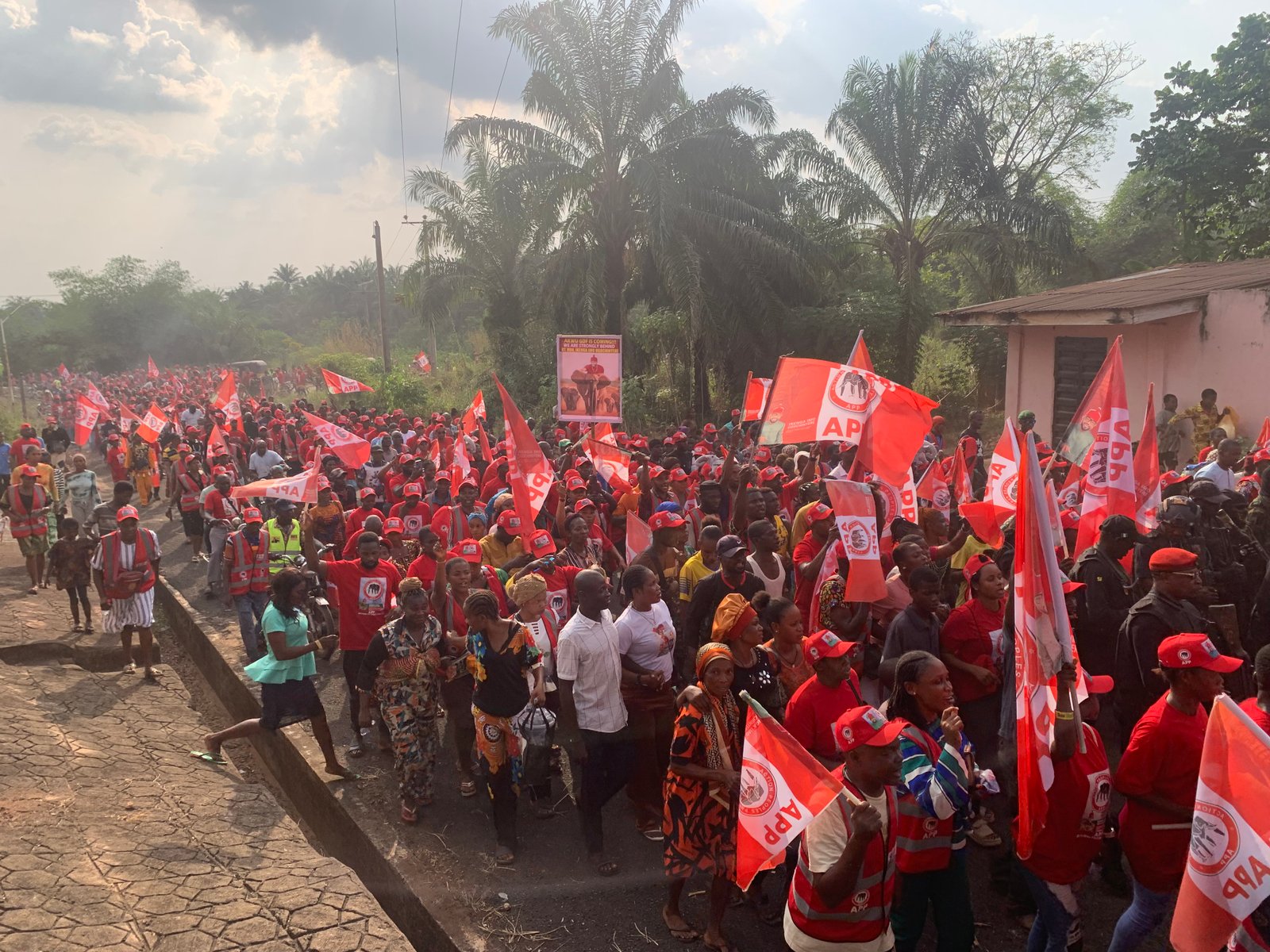
Caption: Supporters of Rep. Ikenga Ugochinyere gather outside the sealed gates of Isiekenesi Primary School 11, the original venue for a civic reception in his honour. The scene underscores the tension between political expression and state authority in Imo State.
ISIEKENESI (IMO STATE) – A planned civic reception for a federal lawmaker descended into controversy and allegations of political suppression on Tuesday, as security forces sealed the primary school venue, barring hundreds of supporters and raising questions about the state of democratic freedoms in Nigeria.
The event, organised by constituents to honour Rep. Ikenga Ugochinyere, the representative for Ideato North and South Federal Constituency, was forcibly relocated after a joint team of police and army personnel barricaded the entrance to Isiekenesi Primary School 11 in Ideato South Local Government Area.
In an impassioned address at an alternative location, Ugochinyere framed the incident not as an isolated administrative hiccup, but as a symptom of a deeper democratic malaise. “I want every Nigerian to see the level we have degenerated,” he stated, describing the action as an “unwarranted provocation by the Imo Police and State Government.”
Context: A Pattern of Political Tension
This event did not occur in a vacuum. Ugochinyere, a member of the opposition Action Peoples Party (APP), claimed the sealing was part of a deliberate pattern of intimidation. He referenced past assassination attempts and the recent destruction of his billboards, suggesting a coordinated effort to stifle his political influence and outreach. His allegation that coordinators received a “midnight text message revoking the use of all public facilities” points to a premeditated strategy to deny the opposition access to communal spaces—a tactic historically used to curb assembly and dissent.
The lawmaker’s call for an investigation by the Inspector-General of Police into the Imo Police Command’s activities highlights a critical issue in Nigerian governance: the alleged weaponization of state security apparatus for political ends. When security forces are perceived to act on behalf of a ruling party rather than as neutral arbiters of public order, public trust erodes and political conflict intensifies.
The Core Democratic Principles at Stake
At the heart of the controversy are two non-negotiable constitutional rights:
- Freedom of Assembly: The constituents’ right to peacefully gather and receive their elected representative.
- Freedom of Association: The right of citizens to identify with and support a political party of their choice, evident in the APP insignias and flags carried by the crowd.
Ugochinyere emphasized that the reception was a civic, not purely partisan, event—a distinction echoed by the Chairman of the occasion, Chief Bonny Ebili, who stated it was about “Ugochinyere’s personality and not about any political party.” This nuance is often lost when state actors view all opposition gatherings as threats.
A Clash of Narratives: Development vs. Political Theatre
The lawmaker’s response strategically shifted the focus from the immediate confrontation to broader governance failures. His challenge to the state government—“If you love my people, build the schools and fix the gully erosions”—contrasts his claimed personal provision of social amenities with alleged state neglect. This frames the conflict as one between a grassroots, development-focused representative and a state government preoccupied with political containment.
By appealing directly to President Bola Tinubu and the National Security Adviser, Ugochinyere elevated the incident from a local dispute to a national concern about “political recklessness” threatening democracy. This move is a common tactic in Nigerian politics, seeking to apply federal pressure on state actors.
The Official Silence and Its Implications
The response from the police spokesperson, DSP Henry Okoye, who stated he was not “officially briefed,” is telling. This lack of an immediate, definitive explanation from security forces often fuels speculation and deepens public suspicion of covert orders and political interference. It leaves a narrative vacuum filled by the allegations of the aggrieved party.
Conclusion: The sealed gates of Isiekenesi Primary School 11 serve as a potent metaphor for a larger struggle. This incident transcends a cancelled party; it touches on fundamental questions about who controls public space, how dissent is managed, and whether the rights to assembly and association are truly guaranteed for all citizens, regardless of political affiliation. The tension in Ideato South is a microcosm of the challenges facing Nigeria’s democratic consolidation, where electoral competition too often spills over into the suppression of basic freedoms.
Reported by Peter Okolie for NAN. Edited by Sam Oditah. (NAN)(www.nannews.ng)


