
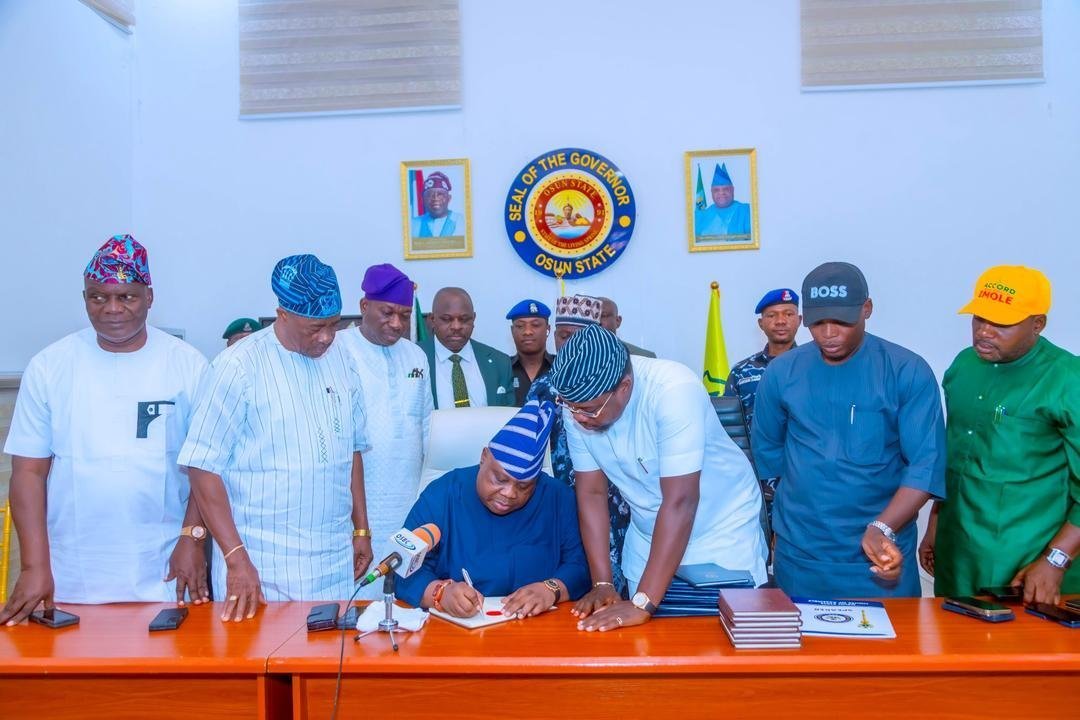
Gov. Ademola Adeleke of Osun State signs the 2026 Appropriation Bill into law at the Executive Council Chambers in Osogbo on Monday, December 29, 2025.
OSOGBO – In a significant move to shape the final year of his first term, Osun State Governor, Senator Ademola Adeleke, has formally enacted the state’s 2026 budget of N723 billion. The signing ceremony, held on Monday in Osogbo, marks a pivotal step in the administration’s fiscal planning, transitioning from budget proposal to actionable law.
The governor performed the executive action in the presence of key government figures, including his deputy, Prince Kola Adewusi, and members of the State Executive Council. This public enactment underscores the budget’s role as the central instrument for governance and service delivery for the coming year.
From Proposal to Law: Understanding the Budget’s Journey
The enacted budget represents a notable increase from the initial proposal. Governor Adeleke presented a fiscal plan of N705 billion to the State House of Assembly on November 12, 2025. Following legislative scrutiny, debate, and potential adjustments to address constituency needs, the Assembly passed an amended version of N723 billion on December 23. This N18 billion upward review highlights the collaborative, yet distinct, roles of the executive and legislative arms in the budgetary process—a fundamental aspect of democratic governance often overlooked in budget reports.
A Budget of Consolidation and Expansion
Governor Adeleke framed the 2026 budget as a dual-purpose instrument designed to both consolidate and expand his administration’s agenda. In practical terms, this means:
- Completion of Legacy Projects: A significant portion of capital expenditure is expected to be channeled towards finalizing ongoing infrastructure and development projects initiated in the last three years, ensuring public funds already invested yield tangible results.
- Launch of New Initiatives: The budget also provides the financial runway for new programs aligned with the administration’s five-point agenda, which typically encompasses areas like infrastructure, education, healthcare, agriculture, and workers’ welfare.
“Our administration has, in the last three budget years, laid a solid foundation for the sustainable development of our dear state,” Adeleke stated. “This budget is our tool to build upon that foundation.”
Contextualizing Performance: Achievements Cited as Precedent
The governor used the occasion to reflect on his administration’s fiscal track record, providing crucial context for the state’s financial health:
- Debt Reduction: Citing statistics from the Debt Management Office (DMO), Adeleke announced that Osun’s debt profile had dropped from approximately 80% in 2022 to 40% by the end of 2025. This suggests a strategic shift from debt servicing to potentially more productive capital investment, a critical metric for sub-national economic sustainability.
- Welfare and Obligations: He highlighted the clearance of inherited liabilities, including billions in pension and salary arrears, and the implementation of previously neglected staff promotions and allowances. This focus aims to boost morale in the civil service—the engine of government implementation—and stimulate the local economy through increased disposable income.
The Road Ahead: Implementation as the True Test
While the signing is a ceremonial milestone, the real work begins with execution. Key questions for observers and citizens in 2026 will include:
- Budget Performance: What percentage of the capital budget will be actually released and cash-backed for projects?
- Fiscal Discipline: Will the administration maintain its debt reduction trajectory while funding ambitious projects?
- Public Scrutiny: How transparent will the procurement and project monitoring processes be to ensure value for the N723 billion allocation?
The governor concluded by commending the people of Osun for their support, framing the budget as a covenant for “public interest and public good.” As the 2026 fiscal year unfolds, the implementation of this N723 billion blueprint will ultimately determine its success in translating financial allocations into improved livelihoods and infrastructure for the people of Osun State.
Reported by Olajide Idowu for the News Agency of Nigeria (NAN). Edited by Modupe Adeloye and Victor Adeoti.


