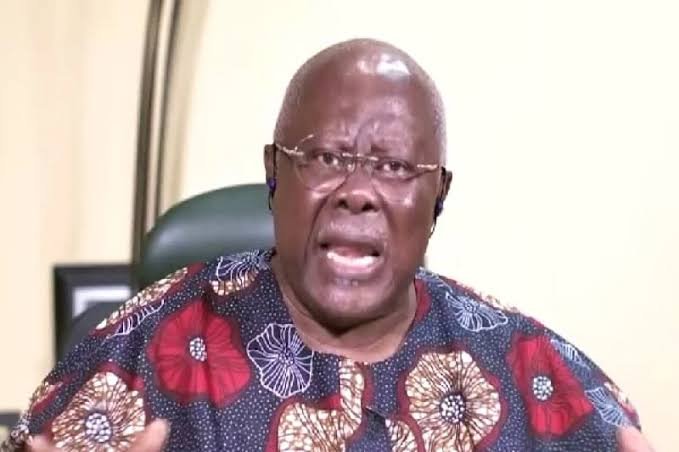
In a powerful intervention that cuts to the heart of Nigeria’s political challenges, Chief Olabode George, former Deputy National Chairman of the Peoples Democratic Party (PDP), has issued a stark warning: the nation’s democracy is imperiled without a strong and functional opposition. His statement, reflecting on Nigeria’s journey and recent developments, serves as a critical diagnosis of systemic weaknesses that extend beyond mere partisan politics.
The Core Principle: Opposition as Democracy’s Immune System
George’s central thesis is foundational: “Democracy without a viable opposition is a dictatorship in disguise.” This is not mere rhetoric. In political science, a robust opposition performs essential functions—scrutinizing government policy, offering credible alternatives, mobilizing public dissent, and ensuring accountability. It is the system’s check-and-balance mechanism. George elaborates, “Democracy thrives on a plurality of ideas, not the silence of the graveyard.” This “silence” he references is the chilling effect created when dissent is marginalized, leading to groupthink within the ruling class and disengagement among the citizenry.
The Concrete Threats: Federalism Under Assault and Institutional Erosion
George moves from principle to practice, pinpointing alarming trends. He decries the reported harassment of Governors Bala Mohammed (Bauchi) and Seyi Makinde (Oyo), framing it not as “mere political skirmish” but as a “calculated assault on federalism.” This is a crucial point. Nigeria’s federal structure is designed to disperse power and protect regional autonomy. When federally-aligned institutions are perceived as targeting opposition state executives, it centralizes power and negates the federal compact. This intimidation, George argues, signals a dangerous drift toward a unitary, authoritarian model where subnational dissent is not tolerated.
Furthermore, he directly addresses the electoral commission, stating, “The credibility of our democracy rests squarely on INEC.” His call for an end to “miracle results and technical glitches” underscores that a viable opposition cannot exist without a truly independent and transparent electoral umpire. If the process of gaining power is flawed, the competition of ideas is rendered meaningless from the start.
The Economic Dimension: Policy Without Scrutiny Harms the People
George wisely connects political health to economic well-being. He cautions against stifling taxes, noting, “While revenue generation is important, it must not come at the cost of the people’s survival.” A weak opposition often fails to rigorously debate economic policies, leading to poorly designed measures that escape necessary refinement. A strong opposition forces the government to better justify its policies, potentially leading to more sustainable and equitable outcomes.
The Cautionary Tale: Learning from Venezuela’s Collapse
His reference to Venezuela is a potent, real-world example. The South American nation’s descent from resource-rich prosperity into crisis was precipitated not just by economic mismanagement but by the systematic suppression of political opposition and the erosion of democratic institutions. George’s warning—”when leadership prioritises power over the people, nations crumble”—uses Venezuela as a sobering mirror, illustrating how the silencing of dissent is often the first step in a nation’s broader decline.
The Path Forward: Beyond Partisanship to Principle
Ultimately, George’s call transcends partisan interest. It is a plea for constitutionalism and institutional integrity. A viable opposition is not just about another party winning elections; it is about preserving the competitive framework that makes democracy self-correcting and resilient. His final admonition, “The soul of our nation depends on it,” elevates the issue from political mechanics to national survival. For democracy to be more than a label, it requires active, protected competition—a lesson as vital for Nigeria as it is for any democracy worldwide.
Edited by Buhari Bolaji