By Philip Yatai | Port Harcourt | Jan. 5, 2026
In a stark warning that underscores the volatile and high-stakes nature of Rivers State politics, the Minister of the Federal Capital Territory (FCT), Mr. Nyesom Wike, has explicitly told the National Secretary of the All Progressives Congress (APC), Senator Ajibola Basiru, to steer clear of the state’s affairs. This directive, delivered during a political ‘thank you’ tour, is not an isolated remark but a significant escalation in the complex power struggle that has defined Rivers politics since Wike’s handpicked successor, Governor Siminalayi Fubara, assumed office.
The confrontation stems from a public rebuke issued by Senator Basiru. On Sunday, he warned the APC’s National Vice-Chairman for the South-South, Victor Giadom, to stop disrespecting Governor Fubara in an attempt to curry favor with Wike. Giadom had previously referred to Fubara as a “so-called governor” and declared that the governor must go through the FCT minister to “get anything” in the state—comments that laid bare the perceived erosion of the governor’s autonomy and the enduring influence of his predecessor.
Wike’s response was unequivocal and laden with threat. “Tell your national secretary to leave Rivers alone, for his own good,” he instructed Giadom, framing the intervention as both unwelcome and perilous. He further cautioned against taking the political support he delivers to President Bola Tinubu “for granted,” a reminder of his value as a powerful ally whose loyalty cannot be presumed upon indefinitely.
Beyond the personal clash, Wike’s speech revealed the raw economic and political incentives fueling the conflict. He issued a broader warning to “greedy politicians” meddling in Rivers affairs because of the “alleged N600 billion in the state treasury.” This pointed reference to the state’s substantial financial resources highlights a central driver of the instability: control over one of Nigeria’s richest fiscal jurisdictions. Wike portrayed the current influx of interest as opportunistic, contrasting it with the lack of support during the difficult political calculations of the 2023 elections. “Now, food is ready and everybody is coming, but when it was hot, nobody was saying anything,” he stated, using a potent Nigerian proverb to accuse latecomers of seeking to profit from a battle they did not fight.
The minister’s declaration of Rivers as a “no go area” and his instruction to “take the one you have taken and stop making unnecessary comments” serve as a territorial claim, asserting his political dominion and attempting to quarantine the state’s internal crisis from external APC interference. This creates a paradoxical situation where a key figure in the ruling party is actively resisting the national party’s involvement in a member-state’s governance, exposing the fragile and often transactional nature of Nigeria’s political alliances.
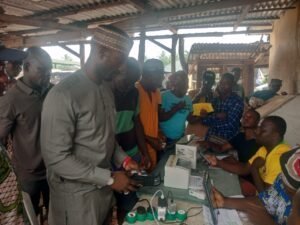
The event itself, a ‘thank you’ visit to Oyigbo Local Government Area, functioned as a demonstration of Wike’s undiminished grassroots power. The pledges of loyalty from local leaders were telling. The Council Chairman promised, “Just say the word, we will hear and will do exactly what you want us to do.” Furthermore, a federal lawmaker lamented that development had stagnated since Wike left the governorship in 2023, a statement that subtly undermines the current administration while reinforcing the narrative of Wike’s effective, if contentious, legacy.
In essence, Wike’s warning to the APC national secretary is far more than a political squabble. It is a multifaceted maneuver to:
1. Assert Control: Reaffirm his status as the primary political force in Rivers State.
2. Protect Territory: Shield the local power struggle from becoming a proxy war for national party factions.
3. Leverage Influence: Remind the APC leadership of his pivotal role in delivering support, thereby negotiating from a position of strength.
4. Control the Narrative: Frame external commentary as greedy interference, rallying local sentiment against “outsiders.”
The concluding remark by the state’s Chairman of Renewed Hope, Amb. Desmond Akawor, that “things will get better with the expected change of leadership in 2027,” is perhaps the most revealing line of all. It signals that for Wike’s camp, the current governance under Fubara is an interim arrangement, and the real political endgame is the next electoral cycle. This warning, therefore, is not just about silencing critics today, but about consolidating power for the battles of tomorrow.
Edited by ‘Wale Sadeeq | Source: NAN News