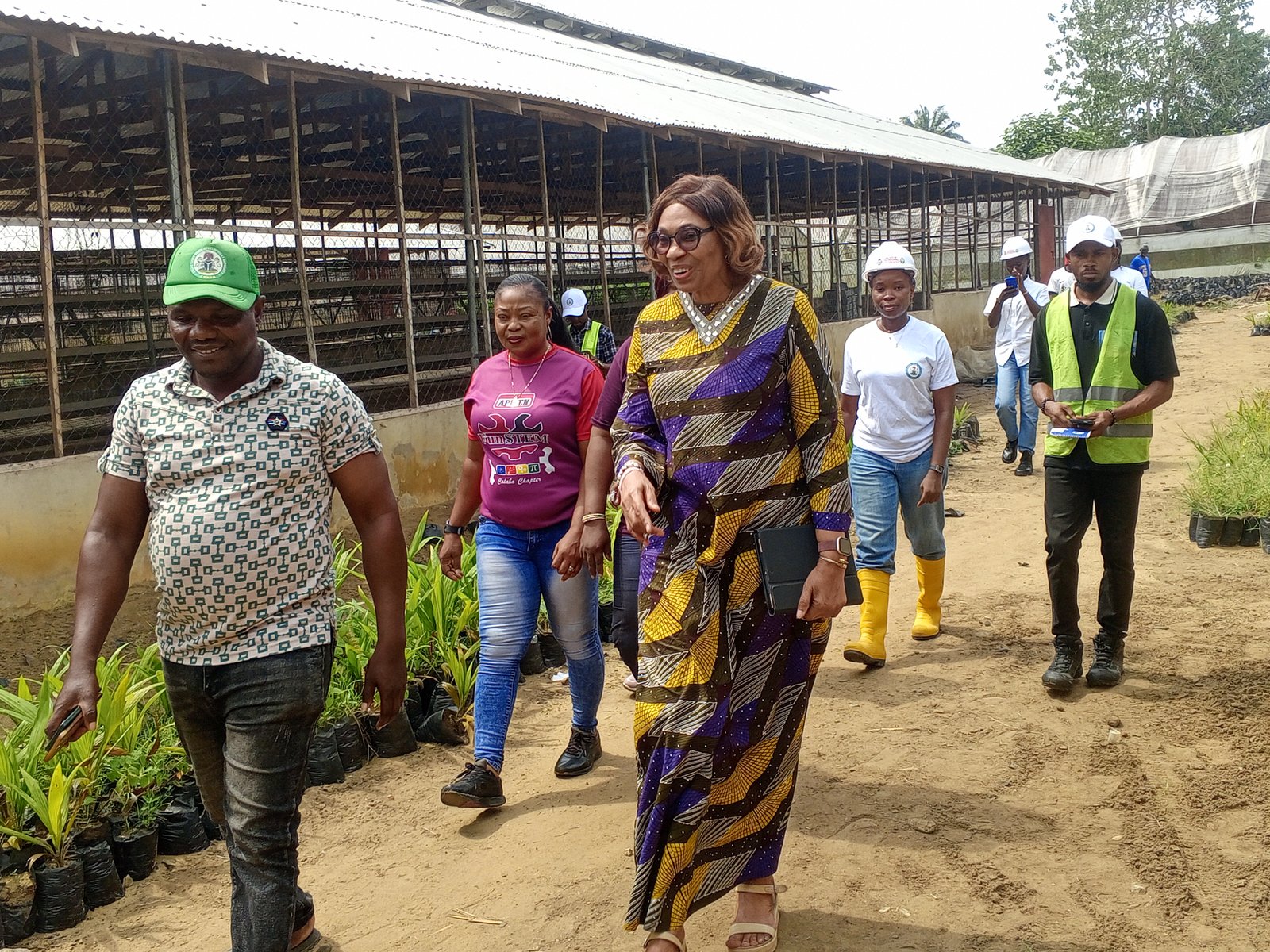
Agronomist, Dr Enow Ayuk, and APWEN President, Dr Adebisi Osim, leading a team of graduate engineers undergoing agronomy and precision agriculture training at the Cross River Basin Development Authority (CRBDA) Integrated Farm in Calabar.
In a strategic move to tackle one of Nigeria’s most pressing challenges, the Association of Professional Women Engineers of Nigeria (APWEN) is pioneering a novel approach: transforming graduate engineers into agricultural problem-solvers. This initiative directly confronts the nation’s food insecurity by merging technical engineering prowess with modern agribusiness, creating a new pipeline of ‘agri-engineers’.
Dr. Adebisi Osim, President of APWEN, articulated the vision behind the training programme for young engineering graduates from the University of Calabar. “Engineers are, at their core, systems thinkers and problem solvers,” she stated. “We are leveraging this innate capability and redirecting it towards the agricultural value chain. Our goal is twofold: to advance the role of women in engineering and to deploy technological innovation for sustainable national development.”
The programme, held at the CRBDA Integrated Farm, represents a significant shift from theoretical knowledge to applied, community-centric engineering. Dr. Osim emphasized that the curriculum is built on practical skills, leadership, and service, empowering trainees to “create sustainable livelihoods through agriculture-driven engineering solutions.” APWEN has committed to ongoing mentorship, including facilitating access to farmland—a critical bridge between training and real-world implementation.
Bridging the Critical Gap: From Theory to Field Application
The training, led by Agronomy Consultant Dr. Enow Ayuk, is meticulously designed to close the pervasive gap between academic engineering and practical agricultural production. Participants receive hands-on instruction in a comprehensive suite of technologies:
- Water Management Systems: Installation of irrigation infrastructure, solar-powered boreholes, and water reticulation networks, which are vital for overcoming seasonal rainfall dependencies.
- Integrated Agricultural Systems: Practical modules in poultry, fish farming, and mushroom production, demonstrating efficient, space-optimized protein sources.
- Precision Agriculture Techniques: Training in greenhouse farming, nursery management, and controlled fertilisation systems, which increase yield while conserving resources.
“This is where engineering meets the soil,” explained Dr. Ayuk. “We are not just teaching farming; we are teaching how to engineer resilience and efficiency into food production. This transforms participants from job seekers into agripreneurs and potential employers of labour, reducing pressure on the formal sector.”
The Trainee Perspective: A Blueprint for Educational Reform
Miss Great Ekeng, a participating trainee, highlighted the transformative impact of the practical exposure. “The classroom teaches the ‘what,’ but here we learn the ‘how,'” she said. “Seeing how precision irrigation can enable year-round cultivation changes your entire perspective on Nigeria’s agricultural potential.” Her call for universities to integrate similar applied programmes underscores a broader need for curricula that align with national challenges and market realities.
The initiative also promotes scalable, individual action. Mrs. Justina Ulafor, an APWEN member, advocated for widespread adoption of backyard farming among professionals. “Food security is a collective responsibility,” she noted. “Mentoring the next generation and applying engineering principles to small-scale urban agriculture can significantly strengthen our local food systems.”
A Model for National Impact
APWEN’s programme is more than a skills acquisition workshop; it is a replicable model for interdisciplinary innovation. By equipping engineers with agronomic knowledge and business acumen, it creates a hybrid professional capable of designing and implementing solutions to inefficiencies in planting, harvesting, water use, and supply chain logistics. This approach addresses food insecurity not merely through increased labour, but through smarter systems—the fundamental domain of engineering.
As Nigeria strives for agricultural self-sufficiency, the fusion of engineering and agribusiness championed by APWEN offers a powerful template. It demonstrates that solving complex socio-economic problems requires breaking down silos between professions and investing in human capital that can build, optimize, and sustain the systems that feed a nation.
Reported by Christian Njoku for NAN. Edited by Ehigimetor Igbaugba/Christiana Fadare.
Source: NAN News